I’ve lived in Colorado for almost two and a half years now. I live a reasonable amount of rock skips away from Rocky Mountain National Park (RMNP) and have gotten very used to making last-minute impromptu weekend trips. During one of my meanders through the gift shop in October of 2021, I found the Passport to Your National Parks book. Boy, did I turn into a national park snob! Since then, I visited Yellowstone, Grand Tetons, and Great Sand Dunes, 3 different parks! On top of my regular visits to RMNP. I was so invested that I even converted my family into national park snobs. With my sister visiting me for the 4th of July weekend, it was a no-brainer to go and knock the Great Sand Dunes (GSD) off our national park bucket list! Read further to learn about the GSD, what you can do while visiting, and some other fun attractions nearby!
What Are the Great Sand Dunes?
Alamosa – “the Gateway to the Great Sand Dunes” – rests just at the interception of highways 17, 160, and 285. The dunes are tucked behind Blanca Peak from the south. I came from the east on HWY 160. I fooled myself into thinking the dunes were not as cool as I had made them out to be in my head. It wasn’t until we turned onto HWY 150 and got past Blanca Peak where we saw the massive mounds of sand. This national park is right up against the Sangre De Cristo Wilderness Mountains to the east but can be seen throughout most of the San Jose Valley to the west.
The Great Sand Dunes are America’s largest dunes. Having grown up in the Midwest, I was always impressed by the Sleeping Bear Dunes (SPD) – located near Traverse City, MI. I was curious how the “Great” Sand Dunes would compare. I’ll tell you more about that, later. Visually, the valley makes the GSD look very grandiose. If you take the road off HWY 150 to the Zapata Falls trailhead (9,000 ft elevation) and look at the dunes, the size displacement against the valley plans makes them look overwhelming. But what makes the GSD so mysterious is the fact that there is a huge amount of sand randomly located in the middle of a mountain range in Colorado!
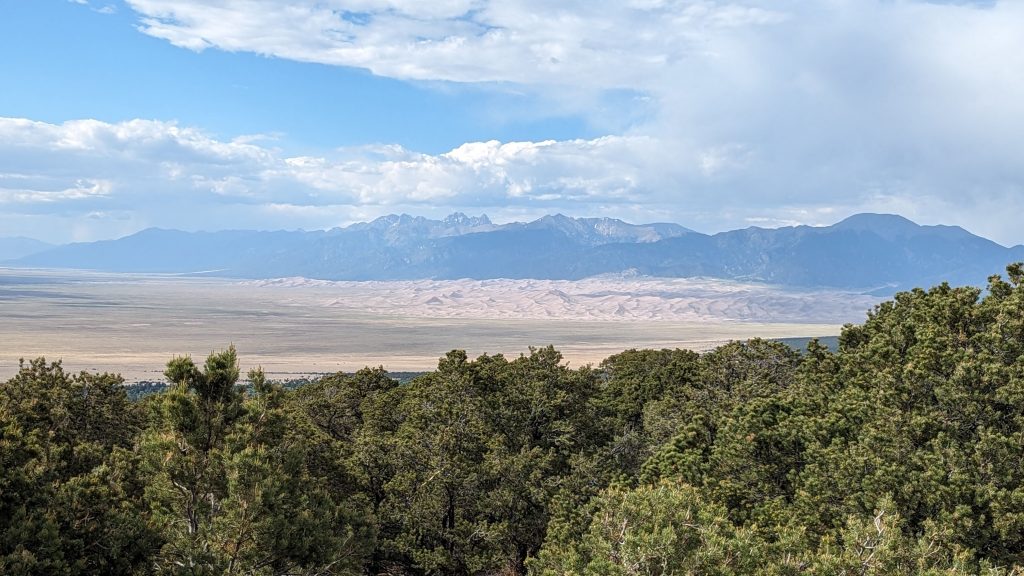
The origins of the GSD are thought to come from a huge lake that once covered a majority of the San Jose Valley. As the lake started reducing, winds from the southwest and northeast collided with each other and cause sand grains to pile up and get stuck where the dunes reside today. The National Park Service (NPS) estimates that the GSD are roughly 440,000 years old! Thanks to the Wilderness Act passed by Congress, the original park covered 33,549 acres. Once the park added the preserve, an additional 41, 676 acres were protected.
What to Do at the Great Sand Dunes
General Activities
While the park is huge, there is not much to access from your car alone. The biggest attractions are hanging out at the foot of the dunes or climbing the dunes. There is camping inside the park at Piñon Flats (reserve here) and backcountry permits are available as well (reserve here). There are also first come, first serve camping spots along a 4WD/AWD high clearance dirt road called Point of No Return. This takes you into the mountains to Medano Pass. While my vehicle has 4WD, it does not have a high clearance and I was not going to test how serious the “point of no return” warning was.
Great Sand Dunes Fees – 2023
Standard Entrance Fee – $25/Vehicle $20/Motorcycle
GSD Annual Pass – $45
Interagency Pass – $80
What We Did
We started the day coming from Cripple Creek and stopped at Bear Basin Ranch for a two-hour horse ride. You can see my review here. From Westcliffe, we traveled down and around the bottom of the Sangre De Cristo Wilderness Mountain Chain and entered the San Jose Valley from the east. I originally wanted to stay at Piñon Flats Campground, but there were no sites available. I was able to get an available tent site at the Alamosa/Great Sand Dunes KOA (website). After checking in and setting up our tent, cots, etc, we decided to check out the park’s gift shop as a preview for the next day. From the KOA, it was a half-hour drive to the park. We spent the rest of the time driving around and scoping out the park to see what we wanted to do the next day.
The main activity we did was hike High Dune – a 1.5 mi trail (3 mi total) that climbs roughly 700 ft in height. Heat stroke is not something to take with a grain of sand…
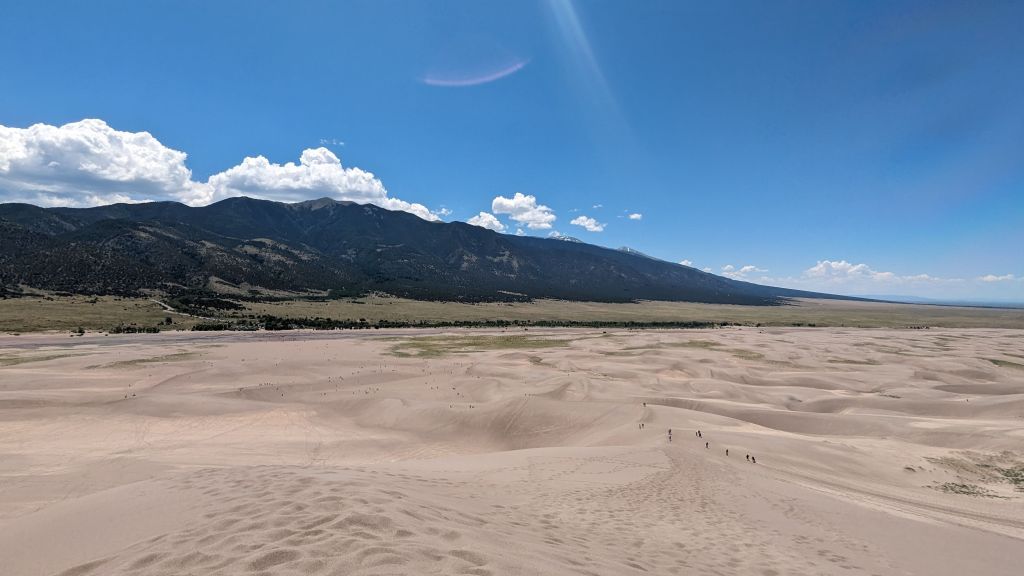
Seriously, don’t be fooled by the short trail value!
- IT IS HOT! Bring water, sunscreen, and a hat with you.
- Wear hiking or tennis shoes. My sister wore rubber clogs and her feet got burned by the extremely hot sand that would fill her shoes.
- Follow the “trail.” There is not a paved trail. The trail is sand but flatten out over the many people who have hiked the dune. It is still sand. One step up can sink two steps down. Take your time. Between the heat and elevation gain, don’t rush yourself. One misstep and you are falling down the side of the sand dune with gravity taking all the way down with it.
- Embrace the bear crawl at the top for the final stretch. The top of the High Dune has very loose sand. Feel free to resort to the bear crawl like I did to finish strong.
- Sand will end up everywhere on you. Know that trying to keep sand off yourself or your items is in vain and will just make hiking more difficult.
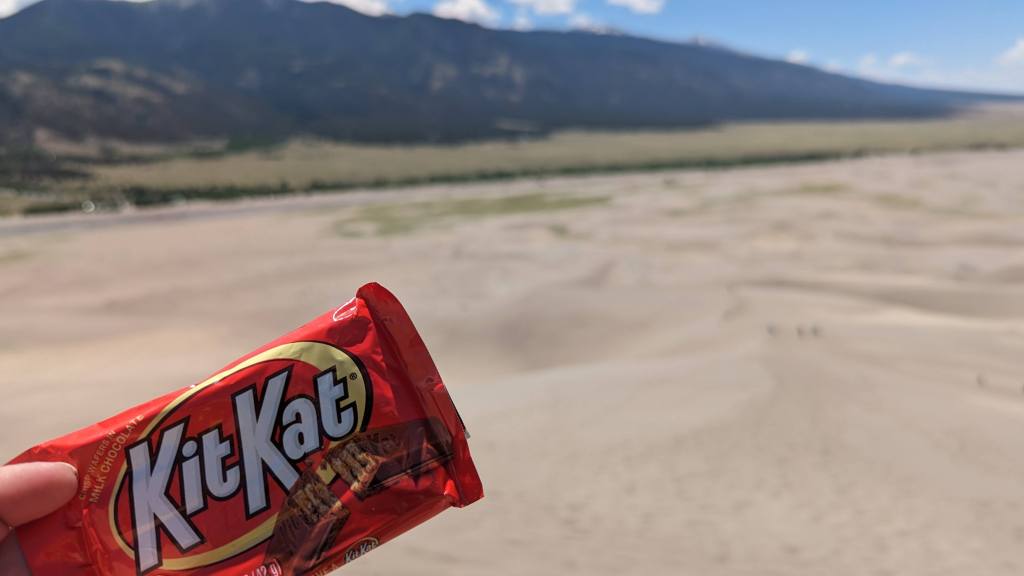
- ENJOY THE VIEW! Sit on top of the dune and pat yourself on the back. You did it! Nice job! Enjoy the candy bar you packed – you earned it!
Final Thoughts
Earlier in the post, I said that I had previously seen The Sleeping Bear Dunes in Michigan. I have to say, you can’t compare these two parks to each. The environments are so different that it makes the parks themselves different. The SBD have a gorgeous lake view that is impressive on its own. But the GSD are called great for a reason. The dune field is huge and covers a large section of land. Each park is worth visiting if you get the chance.
Camping
If you desire camping, Piñon Flats Campground is located inside the park and is for those seeking bare minimum necessities. There is a camp store that sells firewood and ice but due to the remote location, bring cash as a backup in case internet isn’t an option. Pets are allowed, dishes can be washed at utility sinks, and there is a dump station. Food lockers are to be used as it is bear country. This is the only campsite in the park so it will be crowded but travel to the base of the dunes is just down the road. Rates average out at around $20/night.
If you are wanting to be outside the park and closer to Alamosa, I recommend the KOA located two miles east of town on HWY 160. It is a 30-minute drive to the park but has all the amenities. Showers, electricity (even for tent sites!), pancake breakfasts on the weekends, and a full camp store with firewood, ice, camping equipment such as fire sticks for smores, souvenirs, and more! Rates average out at $70/night.

Conclusion
The Great Sand Dunes are a must for anyone with a national park bucket list, traveling through or around Alamosa (or even Pueblo), or anyone just looking for the odd and unusual in the middle of Colorado! Whether you hike a dune, the littles play in the sand, or you enjoy a night sky gazing at stars, a trip to the Great Sand Dunes will give you lasting memories! Have you visited the GSD? Did you venture past the Point of No Return? Comment your stories down below.

Learn more about Scenic Byhorse here.
 Scenic Byhorse