Rocky Mountain National Park [RMNP] is a classic national park. Yellowstone/Grand Tetons probably just edges out over RMNP because they have black and grizzly bears. But the wildlife diversity at RMNP is something to behold. You’ve got pika, marmot, mule deer, big horn sheep, elk, moose, and a small amount of bear and mountain lion. It is rare to see so much in one day, but you better enjoy the encounter when you can!
I got the elusive RMNP+ timed entry that includes access to the Bear Lake Corridor on top of access to the park itself. The entry time was an agonizing 5-7AM sunrise. I’m yawning just hearing that. We stopped by the Starbucks in Estes Park to fuel our empty tanks with some delicious coffee. We were also greeted with a smile to motivate the day by the bumblebee cake pop my sister got. The regular timed entry to the park starts at 9AM. I usually see the Rangers at the fee station around 8AM. Please make sure to support the park and all of its wonderful services by paying your entrance fee.

There are two east entrances for RMNP, one on HW 34 and one that goes through Estes Park on HW 36. Old Fall River Rd is the entrance on HW 34. Beaver Meadows is on HW 36 and is the entrance to Bear Lake Corridor (once past the fee station, the turn for Bear Lake will be on the left). With it being so early in the morning, I decided to drive through the Old Fall River Rd entrance. I’ve been able to see big horn at this time before, but only landscape this morning.
Moose
Since we are not morning people, we just make the Bear Lake reservation time… ok… we were 15 minutes late, but the ranger was very nice and still let us through. We made our way over to Sprague Lake as soon as possible – hoping to see some moose. When we arrived, we did not discover any moose. After hanging out for 30 minutes, we decided to head up to Bear Lake for a hike. It was just at the Bierstadt Lake Trailhead when we saw a moose in the near distance eating bushes. I parked at the Bierstadt Lake Trailhead parking lot. We crossed the road to get to a little hiking trail that would get closer to the moose we saw, but still a safe distance (30ft).
A nice family in a car passed by on the road and stopped to tell us there was a moose just off the trail we should pay attention to. We thanked them for their help as they drove on. We thought they were talking about the one we had seen eating. Continuing to walk the trail, I happened to look over to take in the forest when I saw something move near the ground behind a bush. Keep in mind we were still far from the moose eating bushes. I stop to take a closer look. Lo and behold – it’s a female moose laying down just 15 ft away from us.
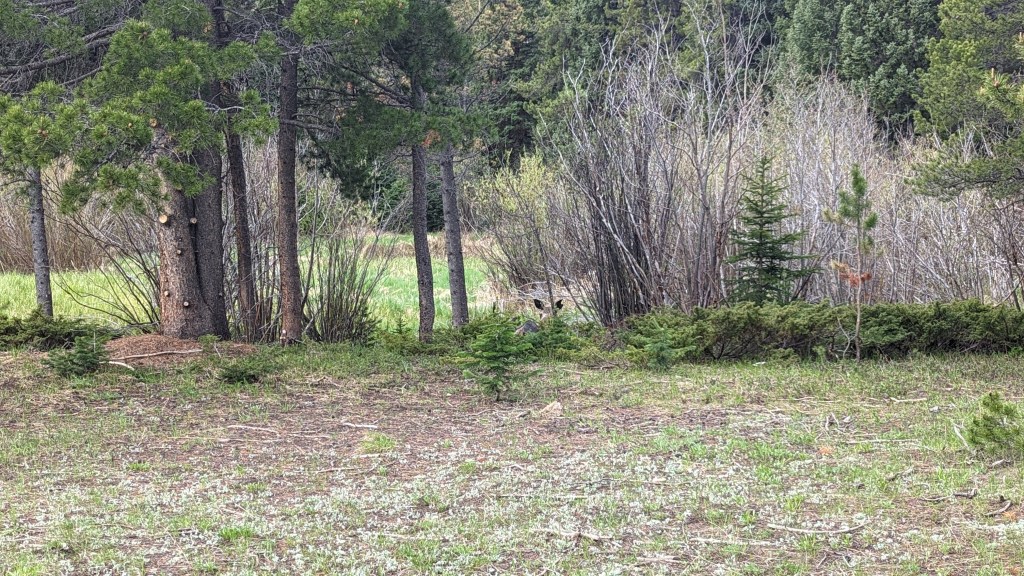
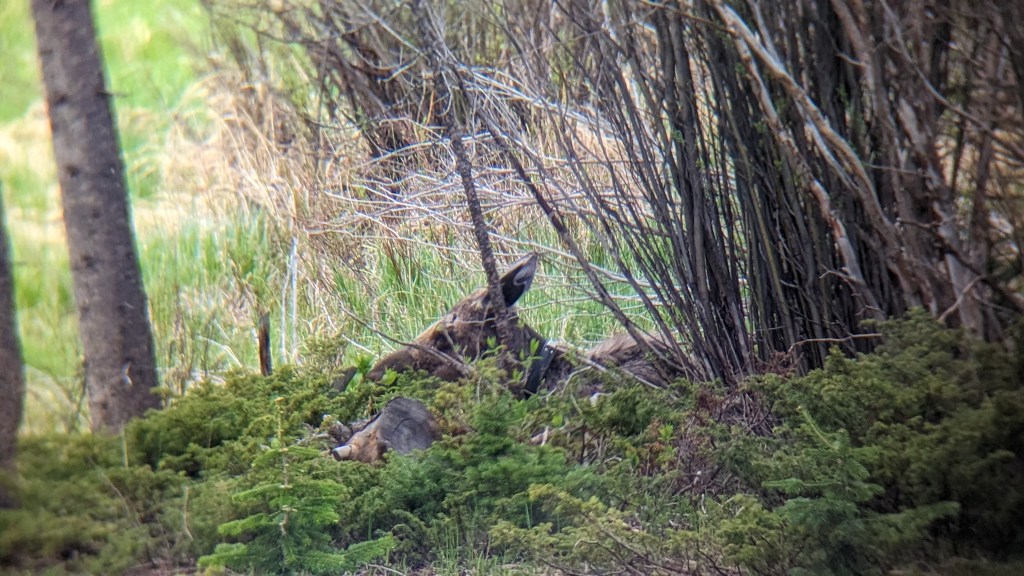
Recognizing our proximity, my sister and I slowly continued walking along the trail to a safe distance. I was able to take pictures at this point. Picture this terrain: there is the road and a sharp drop about 5 feet. Then some flat grass area about 20 feet wide where the trail runs through. Then another drop, but this one is only a foot. The 1-foot drop is lined with bushes and a few trees. The moose was laying behind the bushes and her body was covered by the 1-foot drop.
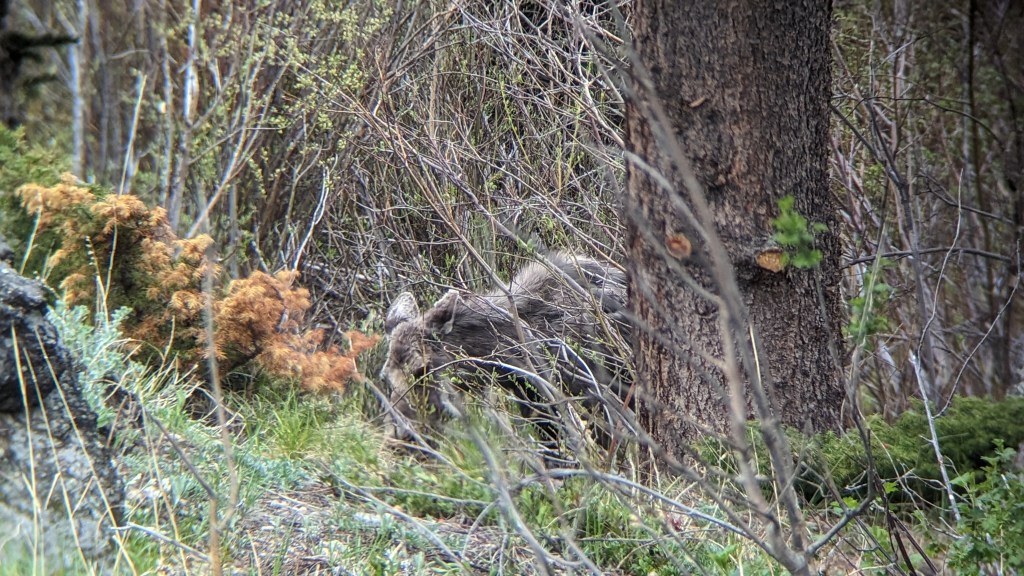
After admiring the moose laying down, we continued to hike to where we saw the original moose. She was further into the forest but still eating. At this point of the year, you can tell males from females. Males have started to grow back their antlers. The antlers may still be nubs or very short, but you will be able to see the difference. Females also start to calf around this time of year as well. Both moose did not have any signs of antlers growing in, which makes me think they were both females. Once we properly enjoyed viewing the moose, we got back to the car and continued driving to Bear Lake.
Bear Lake
Some things to keep in mind for hiking in Bear Lake around early June:
- Bear Lake Corridor requires a timed entry from 5AM to 6PM. You can make a reservation here. Additionally, new to 2023, if you have an early timed entry to Bear Lake and leave, you are allowed to re-enter after 2PM.
- Learn about the amount of snowfall from the winter. This determines how fast or slow the trails will clear. This year, the 2022-2023 winter, had record snow totals. This caused the snow to stick around until the 4th of July weekend!
- Get to the parking lot before 9AM. Once the Bear Lake parking lot is full, it is almost guaranteed the ranger or volunteer directing traffic at the entrance of the parking lot will not let anyone in. They will tell you to turn around and make your way back to the Park & Ride (across from Glacier Basin Campground) to take the shuttle up to Bear Lake.
- Learn about the trails offered. Bear Lake itself is a 0.6 mi lake loop. I recommend this loop especially in fall when all the leaves are changing colors. There is also Nymph Lake/Dream Lake. From Dream Lake, you can venture to Emerald Lake or Lake Haiyaha. My personal favorite is Lake Haiyaha. Due to a landslide, minerals turned the lake into a gorgeous turquoise color that is very unique and worth the hike!
- Don’t be fooled by mile distance. Sure, 1.1 mi to Dream Lake doesn’t sound bad, but remember, you are climbing. Climbing doesn’t offer much to knock out chunks of mileage. You are also between 9,500-10,000 feet in elevation. The colder air does affect your lungs and breathing. TAKE YOUR TIME! Slow and steady is the way to go. Monitor your heart rate and know what your max heart rate can be.
- Wear hiking or tennis shoes and pack appropriately. The Rocky Mountains are called rocky because? Seriously, the terrain can go huge stretches of small to medium rocks on the trail, and near Lake Haiyaha, you are literally climbing over huge boulders to get to the final stretch before the lake. Higher elevation means harsher sun rays and lakes mean mosquitoes. Bring sunglasses, sunscreen, bug spray, a hat, and I like to use trekking poles. Bring water! Stay hydrated!
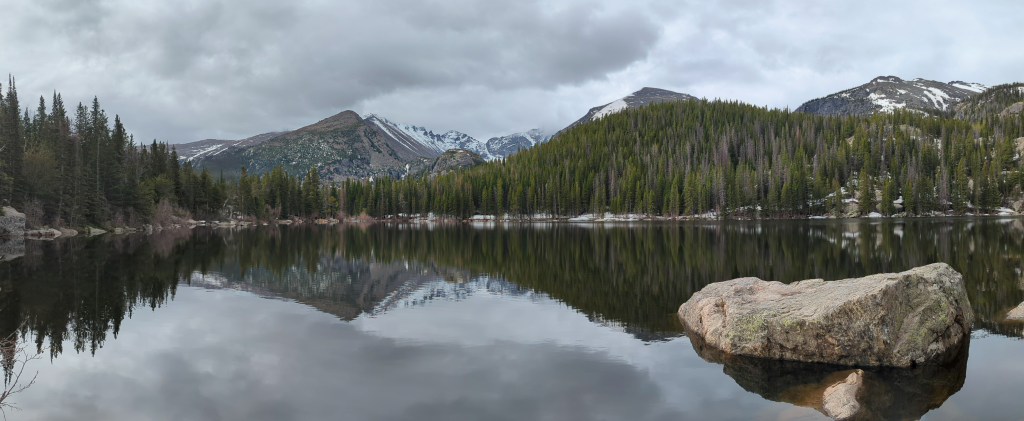
While all the bigger trails were covered in snow, the Bear Lake loop was clear (mostly). We enjoyed walking the loop and getting pictures of the various points around the lake. You’ll get picturesque Bob Ross-styled captures. The pretty mountains are reflected by the lake.
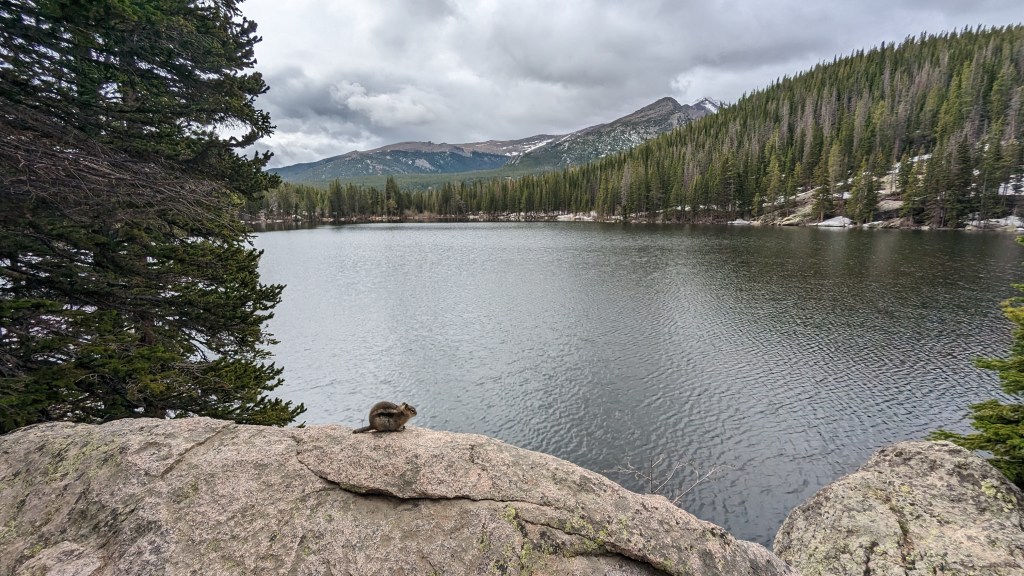
We even “hung out” with a chipmunk who coincidently posed on a rock with the lake in the background. What a fun picture? There was also a rare sighting of a female dusky grouse. Grouse are medium to large-sized birds with round bodies and feathered legs. Males are usually colored to attract females. Dusky grouse females are brown and speckled while males look like they have a brown “beard,” these feathers fan out to show a white circle with a red dot in the middle. When looking at the male straight on, it looks like a pair of intimidating eyes!

More Moose and a Bull Elk
Once we left the Bear Lake Corridor, we headed towards Trail Ridge Road. It was about a half mile past the Deer Mountain trailhead where we saw a mama moose and her yearly grazing on the side of the road. I would also like to kindly remind you to pull all the way over when you want to stop for wildlife. All four wheels should cross the white line. There were some cars that did not do this, and a ranger vehicle drove by and had to tell people to move. They then missed seeing the moose because they had to move their vehicle.
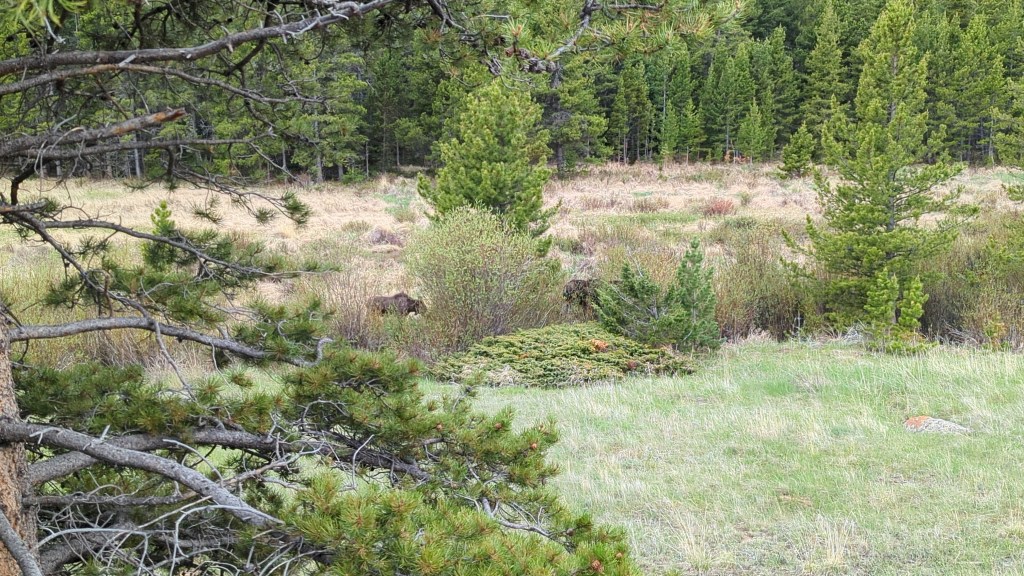
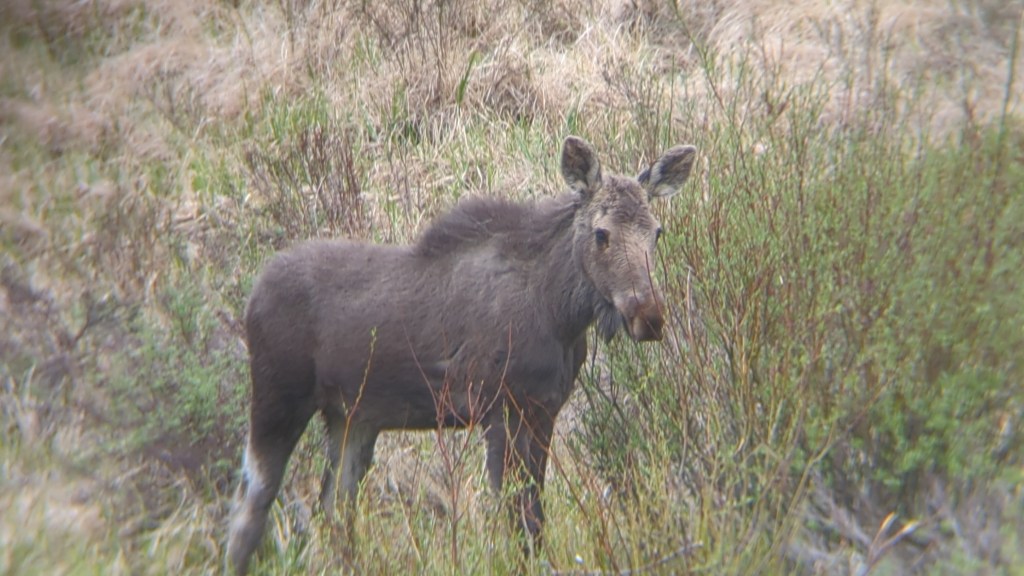
One tip for those who can’t or refuse to get a “fancy” camera, hold a pair of binoculars up to your phone camera. It will act as an extra “zoom.” I recommend playing around with this to get the settings right. You don’t want to miss anything because you were fumbling with your equipment. This is a great example of how you can use binoculars to zoom in on an animal. On the left is the regular picture of the moose. On the right is a picture using binoculars.
We ended the visit with a great sight of a bull elk with his rack almost fully regrown! Interestingly enough, what dictates antler growth is more daylight that summer provides and an increased testosterone – which comes with age. Elk mate by creating a harem of cows (female elk). In August, September, and October, you can hear elk bugles throughout the park! But mating happens in September and October in the park’s meadows and valleys.

Conclusion
Rocky Mountain National Park always has new adventures and new wildlife to see every time you visit. From elk to moose and everything in between, you will never see “all” of RMNP. Trail Ridge road wraps around the northern perimeter of RMNP, so there is vast land yet where wildlife thrives and enjoys human-free interactions with nature!
Have you been to Rocky Mountain National Park? What wildlife did you see? What places did you visit? Comment below to let me know!

Learn more about Scenic Byhorse here.
 Scenic Byhorse
hey
cool blog 🙂 will give it a follow and a like !
LikeLike